BEATRIZ AMIGOT
Share on Facebook
Share on Twitter
Share on LinkedIn
Send by email
Real estate investment surges 50% and exceeds 10 billion
Housing prices spike 12.9% in the first quarter: where are the strongest increases?
How many years of salary are needed in each province to afford an apartment?
Real estate values rise on average 13.3% in Spanish cities during the first quarter, but in some like Segovia, Oviedo, and Santa Cruz de Tenerife, increases soar above 20%.
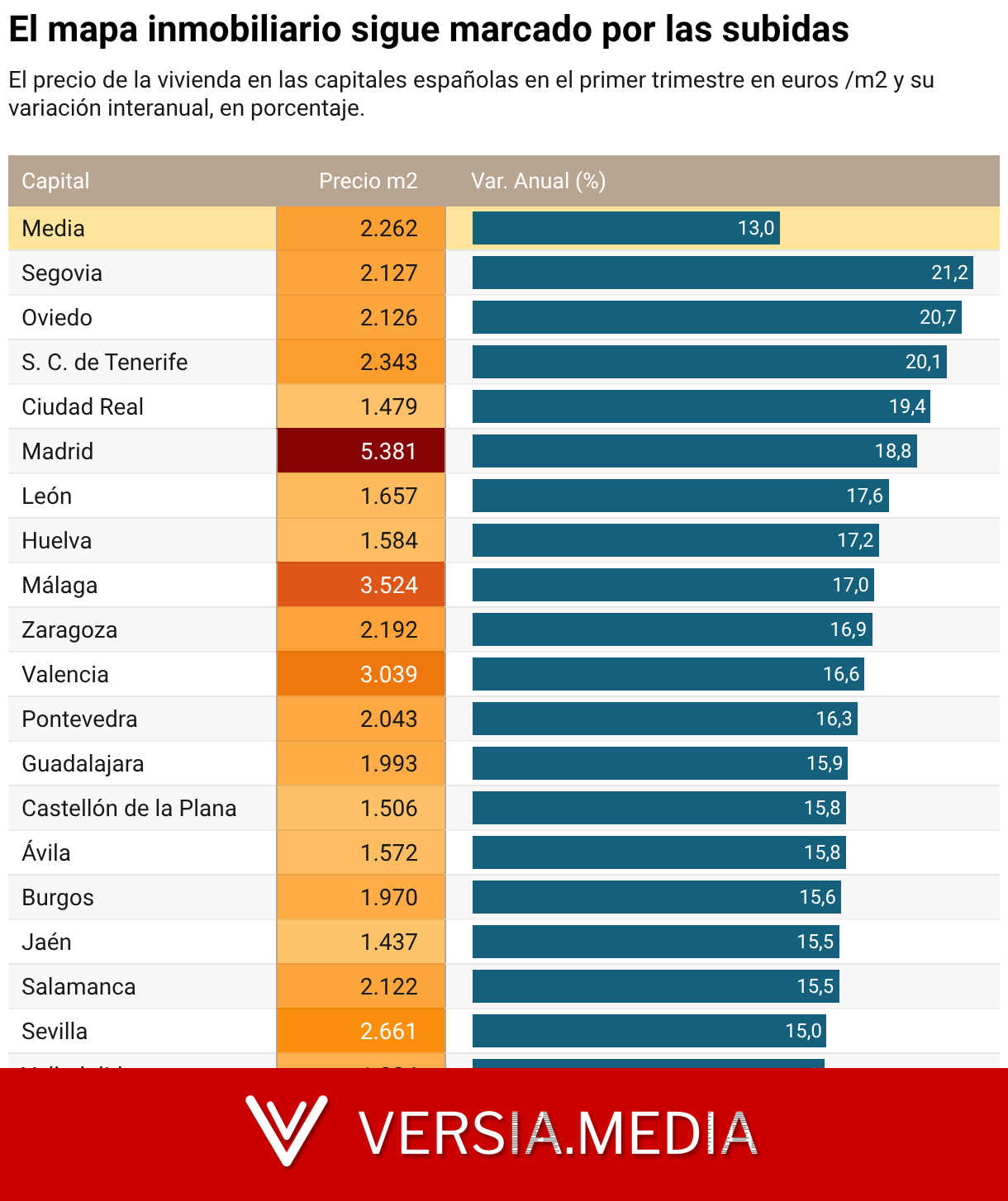
The housing market is entering a new deceleration phase, with sales declining and a less attractive financial environment. For now, this slowdown is not being reflected in prices, although the pace of increases may be nearing a peak. In the first quarter, the average home value in Spanish provincial capitals stood at 2,262 euros/m², representing an annual increase of 13.26%, according to the first 'Provincial Capital Residential Market Barometer' prepared by consultancy Gloval and reported by EXPANSIÓN. This trend aligns with the 12.9% rise for the entire country shown by figures from the National Statistics Institute published this same week.
The report highlights that real estate prices rose in all provincial capitals during the first months of 2026. The largest increases were observed in Segovia (21.20%), followed by Oviedo (20.66%), Santa Cruz de Tenerife (20.09%), Ciudad Real (19.37%), and Madrid (18.79%).
Also notable were the advances in Huelva, Málaga, Pontevedra, Castellón de la Plana, Guadalajara, Ávila, Burgos, Jaén, Salamanca, and Sevilla, all recording growth above 15%.
Increases spread from north to south and across quite diverse locations, although a pattern seen during 2025 repeated this quarter: Madrid's pull is spreading the upward trend to nearby and well-connected provinces such as Segovia, Guadalajara, and Ávila.
On the other side, the most moderate increase occurred in Huesca (4.4%). In this Aragonese city, the residential market is in full deceleration, with home sales plummeting 18.2% at the close of 2025.
It was followed by Badajoz (5.6%), Girona (6.0%), Lugo (6.1%), and Melilla (6.3%). In up to thirteen cities, increases in the first three months of the year were below 10%. In addition to those already mentioned, the list includes: Ceuta (6.6%), Vitoria (7.3%), Cádiz (7.5%), Teruel (8.6%), Ourense (9.3%), Palencia (9.5%), Tarragona (9.7%), and Pamplona (9.8%). Generally, these are less dynamic markets with a more local and limited buyer base.
"The data show a residential market where home prices continue to rise broadly, even in a context of lower transactional activity. This trend confirms the existing pressure on residential values, marked by ongoing demand, limited available housing stock in many markets, and a progressive deterioration in affordability," explains Roberto Rey, president and CEO of Gloval.
The study notes that the number of apartments for sale on real estate portals has fallen by 13.7% in the last year. "Therefore, it will be key to closely monitor the evolution of household effort [currently, housing payments already account for 35.5% of gross income for Spanish households] and the capacity to generate new supply," adds Rey.
Prices
Following the latest increases, San Sebastián positions itself as Spain's most expensive capital, with an average value of 5,628 euros/m². It is followed by Madrid, at 5,381 euros/m²; Barcelona, at 4,676 euros/m²; Palma, at 4,226 euros/m²; Bilbao, at 3,598 euros/m²; and Málaga, at 3,524 euros/m². All of them are clearly above the average for capitals and represent the hottest spots in Spanish real estate.
At the opposite end, the cities with the lowest values are Zamora, at 1,271 euros/m²; Lugo, at 1,343 euros/m²; Palencia, at 1,409 euros/m²; Lleida, at 1,433 euros/m²; Jaén, at 1,437 euros/m²; Ciudad Real, at 1,479 euros/m²; Castellón de la Plana, at 1,506 euros/m²; Badajoz, Cuenca, and Cáceres, at 1,516 euros/m² in both cases.
Cycle change?
Despite this rising price context, the market is beginning to cool. The analysis highlights that the slowdown in transactional activity is already evident. According to the barometer, home sales in the capitals fell by 5.65% year-on-year at the close of 2025. Furthermore, this trend continues in the early stages of this year across the entire country. According to the latest data from registrars, operations dropped by 3.2% in April, marking four consecutive months in negative territory.
Added to this is a financial environment with certain restrictions and less appeal. The average interest rate on new mortgages climbed to 2.80% in April, the highest level in 14 months, according to the Bank of Spain.
This jump reflects the impact of the war in the Middle East and the rise of the euribor, which already anticipated the interest rate hike recently implemented by the European Central Bank. This past Thursday, the institution raised the price of money to 2.25%. But the market even contemplates two more increases this year.
"A more prudent financial environment is expected, with presumably more restrictive credit access conditions, which adds friction to the market," says María Matos, director of Studies at Fotocasa.
Under these circumstances, experts are already talking about a cycle change, although its scope remains to be seen. "We see how homes stay on the market longer, buyers make decisions more thoughtfully, are more selective, and occasional price adjustments begin to appear, especially in those properties that come out with expectations far from reality," points out Matos.
In this regard, Francisco Iñareta, spokesperson for Idealista, notes that recent declines in operations "could be interpreted as a cycle change, or at least a stabilization at the national level of buyer appetite. The high prices reached by housing, especially in the most dynamic markets, and the increase in financing costs seem to be responsible for the withdrawal of demand and anticipate a stabilization of prices in the medium term."
For Karina Katrib, director of Gloval Analytics, "it is likely that we will enter a phase of price growth deceleration, but not necessarily a phase of significant correction at the national level."
"The main reason is that today the Spanish residential market is much more conditioned by supply scarcity than by credit, unlike what happened in previous cycles. The challenge is no longer so much financial stability as affordability and access to housing," concludes Katrib.
Real Estate
Housing Market
01:49 Prosegur Security will make the US its main market
Prosegur Security will make the US its main market
01:25 Kevin Warsh will debut at the Fed without rate cuts
Kevin Warsh will debut at the Fed without rate cuts
01:00 Orcel takes the first step in his European escalation
Orcel takes the first step in his European escalation
00:37 American Express buys TheFork to strengthen in dining
American Express buys TheFork to strengthen in dining
00:09 The end of the conflict would allow the ECB not to raise rates further
The end of the conflict would allow the ECB not to raise rates further